Which Phone Case Brands Are Best for Durability?
Quick Summary
The most durable phone case brands use a rigid polycarbonate shell over a shock-absorbing TPU or elastomer liner, with raised screen and camera edges and reinforced corners. Corners take most real-world impact, so corner geometry predicts durability better than a high drop rating. Check how the layers are bonded and what the warranty actually covers before you buy.
- A drop rating means little unless the test height, surface, number of drops and orientations are disclosed.
- Pair a rigid polycarbonate shell with a shock-absorbing TPU or elastomer inner layer for the best balance.
- Look for thicker corner walls and raised lips, since corners take most of the impact in a typical fall.
- TPU tends to yellow over time, especially in direct sunlight.
- Read the warranty to see whether it covers accidental drop damage or only manufacturing defects.
Table of Contents
- How We Evaluated Durable Phone Case Brands
- Phone Case Materials for Protection and What Each One Does Best
- Phone Case Drop Protection: What the Numbers Mean in Practice
- Best Rugged Phone Case Brands Compared
- OtterBox Alternatives for Everyday and Field Use
- Durability Beyond Drops: Wear, Failure Modes, and Warranty Policies
- Choosing Your Next Durable Case From Bluebox Wireless
- Frequently Asked Questions
How We Evaluated Durable Phone Case Brands
Last Updated: October 26, 2026
One drop onto a kitchen tile tells you little about how a case performs after two years in a pocket with keys and coins. This guide discusses phone case durability by construction, drop performance, and long-term wear.
Consider construction, impact handling, aging, and warranty promises when comparing cases.
Our criteria were:
- Construction: Whether the case uses a rigid inner shell, a flexible outer layer, or both, and how those layers are joined.
- Corner and edge protection: Corners take most of the impact in a typical fall, so raised lips and reinforced corners matter more than a thick back panel.
- Material resilience: How the material handles scratches, UV exposure, and repeated flexing over time.
What Independent Testing Does and Does Not Show
Many brands publish drop-test results but few explain the method. A 1.5-meter drop onto concrete tells you something; the same drop onto a padded surface tells you much less.
Independent testing has limits too: a single drop test does not capture long-term wear, grip changes, or repeated small impacts. Treat published results as one data point and weigh construction and warranty terms alongside them.
Phone Case Materials for Protection and What Each One Does Best
Material choice shapes how a case handles impact, scratches, and time. Most protective cases combine two or more materials.
- Polycarbonate (PC): A rigid plastic that resists cracking and holds shape. It is common in the inner or outer shell of protective cases.
- Thermoplastic polyurethane (TPU): A flexible elastomer that absorbs shock and grips well. It tends to yellow over time, especially in direct sunlight.
- Silicone: Soft and grippy, but it attracts dust and can stain. It works best as a secondary layer, not the main protective structure.
For most users, a rigid shell paired with a shock-absorbing TPU or elastomer layer gives the best balance of protection and bulk. Also ask how the layers are bonded: a case that peels apart at the edge has failed regardless of material.
Phone Case Drop Protection: What the Numbers Mean in Practice
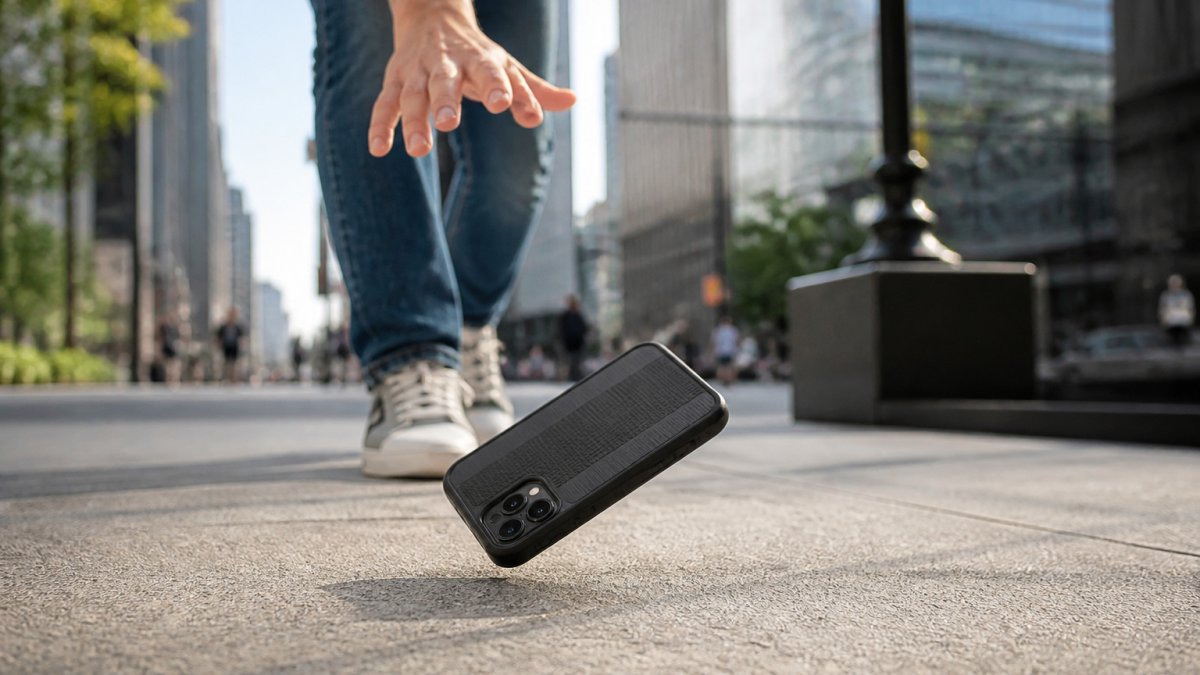
Drop ratings sound precise but rarely translate to daily use. A 2-meter rating was earned under specific conditions; your phone may land at a different angle, surface, and speed. The useful skill is reading the test method behind the number, not memorizing the highest one.
A Repeatable Way to Read Any Drop-Test Claim
When you see a drop rating, run it through these five questions. If a brand cannot answer them on the product page or in its support documentation, treat the rating as unverified.
- What was the drop height? Most brands test between 1.2 and 2.4 meters. A higher number is better only if the method is stated.
- What surface was used? Concrete and tile are harsher than carpet or grass. A test on a padded surface tells you much less than one on concrete.
- How many drops, and in which orientations? One drop per face and corner is a more thorough protocol than a single drop on the back. Look for whether corners, edges, and screen-down impacts were included.
- What was the phone condition after each drop? A case that protects the screen but cracks in the process has still done its job, but you need to know whether the case itself remains usable and whether the phone stayed functional.
- Was the test repeated on the same unit or on fresh units? Repeated drops on one case show how it degrades; fresh units per drop show best-case performance. Both are useful, but they answer different questions.
A drop rating is only comparable when the height, surface, number of drops, and orientations are disclosed. Without those four details, a higher number does not mean better protection.
What Standardized Testing Can and Cannot Tell You
Some brands cite standardized or independently verified testing, but a lab test isolates one variable while daily life combines many. Treat published results as one data point, not a verdict.
Cases often perform well on the first drop and degrade after repeated impacts at the same corner. That is why a rigid outer shell with a shock-absorbing inner liner often outperforms a thicker single-material case over time: the layers share the load.
Matching Test Conditions to Your Real Risks
Match test conditions to your actual use:
- Pocket and desk drops: Low height, hard indoor surfaces. Corner and edge protection matter most; a raised screen lip prevents face-down scratches.
- Outdoor and field work: Higher drops onto concrete or gravel, often at angles. Multi-layer construction with reinforced corners and port covers is worth the bulk.
- Gym, travel, and commuting: Repeated small impacts and pressure in bags. Check button and port durability, not just drop height.
Corners, Edges, and the Geometry That Decides Outcomes
Most real-world damage starts at a corner. A case with raised screen and camera edges plus reinforced corners protects more than one with a thick back and flat edges. Between similar ratings, compare corner wall thickness and whether corners have an internal bumper; that geometry predicts real-world performance better than the headline number.
Do not assume a higher drop rating means better everyday protection. A case rated for a high drop on a padded surface may protect less on a kitchen tile than a lower-rated case tested on concrete with corner-specific drops.
Best Rugged Phone Case Brands Compared
Rugged cases are built for heavy use, with thicker profiles, multiple layers, and often port covers. They suit outdoor workers, frequent travelers, and people who drop their phones often. The trade-off is bulk and weight.
Rather than rank logos, compare rugged brands on layer construction, fit for your exact phone, warranty coverage, and whether protection blocks features you rely on. For a heavy-duty armor shockproof case you can buy now, see heavy-duty armor shockproof case.
Rugged Case Construction Patterns and What They Mean
| Construction Pattern | Typical Build | Protection Strength | Bulk and Weight | Feature Trade-offs to Check | Best For |
|---|---|---|---|---|---|
| Multi-layer defender style | Rigid polycarbonate outer shell over a shock-absorbing TPU or elastomer inner liner, often with a raised screen lip and reinforced corners | High; the rigid shell spreads impact while the soft liner absorbs it | High; usually the thickest option | Port covers can block easy charging access; some models reduce wireless charging speed or require precise alignment; button covers may feel stiffer | Field work, construction, outdoor use, frequent hard drops |
| Single-piece rugged TPU | Thick molded TPU with reinforced corners and raised edges | Moderate to high; relies on material thickness and corner geometry | Moderate to high | TPU can yellow with UV exposure; grip may degrade as oils build up; check button cutouts for accuracy | Daily carry with frequent drops, travel |
| Hybrid slim-rugged | Thin polycarbonate back bonded to a TPU bumper, with raised camera and screen edges | Moderate; focused on corner and edge impact rather than full-body coverage | Low to moderate | Back panel may scratch; corner walls can be thinner, so hard corner falls are the weak point; confirm camera clearance | Users who want protection without pocket bulk |
| Wallet or folio rugged | Rugged shell plus a folding cover, sometimes with magnetic closure | Moderate; cover adds screen protection but hinge and closure are wear points | Moderate to high | Cover can interfere with wireless charging and magnetic accessories; hinge wear is a common long-term failure | People who want screen coverage and card storage |
Specific protection ratings, warranty periods, and prices change often. Check each brand’s current product page before you buy.
How to Compare Named Brands Without Guessing
Most major rugged brands publish enough detail to compare them. Use these checks:
- Layer bonding: Look for language describing how the inner liner and outer shell are joined. A case that peels apart at the edge has failed regardless of material quality.
- Corner reinforcement: Check whether corners have extra material or an internal bumper. Corners take most real-world impact.
- Raised lips: Confirm the screen lip and camera ring height. A raised camera ring protects the lens; a flat back does not.
When a brand lists a drop rating, note whether it states the test height, surface, and number of drops. A rating without a method is a marketing number, not a comparable specification.
Pros and Cons by Construction Pattern
Multi-layer defender style
- Pros: Strong multi-layer protection, often with port covers and reinforced corners. The rigid-plus-flexible build handles sharp and repeated impacts well.
- Cons: Bulky and heavy. Some models reduce button feel or interfere with wireless charging.
Single-piece rugged TPU
- Pros: Simpler construction with fewer failure points, usually lighter than defender-style cases, and often grippier.
- Cons: TPU can yellow and its grip can fade. Protection depends on corner thickness, so check corner geometry rather than the back panel.
Hybrid slim-rugged
- Pros: A good balance of protection and everyday comfort, with clear specs and reasonable fit for popular models.
- Cons: Less protection than full rugged cases, especially on hard corner falls. Check whether the warranty covers drop damage or only defects.
Wallet or folio rugged
- Pros: Adds screen coverage and card storage, which suits people who carry both.
- Cons: Hinges and magnetic closures wear over time, and the cover can block wireless charging or magnetic accessories.
Compare construction and fit on product pages. Run the same six checks against the brands you are considering.
OtterBox Alternatives for Everyday and Field Use
OtterBox is a well-known rugged name, but not the only option. If you want an OtterBox alternative, browse this shockproof defender-style case.
For everyday use, look for a rigid shell, a shock-absorbing inner layer, and raised edges around the screen and camera.
For field use, prioritize full coverage, port covers, and construction that handles repeated impacts. Heavier cases make sense here, but check button and charging fit before committing.
If you are looking for a more premium look without giving up protection, a matte or leather-finish case can work well. You can view a rugged armor leather case with a matte finish.
Durability Beyond Drops: Wear, Failure Modes, and Warranty Policies
Drop protection gets the attention, but many cases fail for other reasons. Knowing the common failure modes helps you judge long-term durability.
- Yellowing: TPU and some clear cases yellow after months of sun exposure. Choose a case with UV-stable materials if appearance matters to you.
- Cracking at the edges: Thin polycarbonate can crack where the case flexes. Look for thicker walls at the edges and corners.
- Delamination: Layers can separate over time, especially where two materials meet. This often shows up first as a lifted edge.
Warranty terms catch many buyers out. Before you buy, read the store’s return and refund policy.
We recommend reading any warranty carefully, whatever brand you choose, and keeping your receipt in case you need to make a claim.
Choosing Your Next Durable Case From Bluebox Wireless
The best durable case matches how you use your phone. Drop it often? Prioritize corner protection and rigid-plus-flexible construction. Hate bulk?
Before buying, check three things: exact model fit, intact wireless charging and button feel, and warranty terms that match your expectations.
Bluebox Wireless offers free shipping on orders over $50. Browse the current range and find the protection level that fits how you live.
Frequently Asked Questions
What’s the best brand of phone case for durability?
No single brand wins every category. Rugged-focused brands generally offer the strongest drop protection, while slimmer brands usually trade some impact resistance for a lighter feel. Start by deciding how much protection you need: everyday knocks, regular drops onto hard surfaces, or field work. Then compare drop ratings, materials, and warranty terms for the brands that fit that need. Check whether a brand publishes its testing method, since transparent test details make claims easier to verify.
Is anything better than OtterBox?
When comparing cases, consider construction, fit, and the protection features described on the product page. Compare the case’s bulk and weight against how you actually carry your phone. Check current listings for pricing.
How can I tell whether a phone case offers reliable drop protection?
Look for a stated drop height and the test standard behind it, and be cautious of vague claims like ‘military grade’ without details. Check that corners are reinforced, that the case has raised edges above the screen and camera, and that the inner shell is rigid rather than only soft material. Reviews that describe real drops over several months are more useful than a single lab result. Also note whether the warranty covers drop damage.
Are rugged phone cases worth it for everyday use?
For many people, a rugged case is worth it if the phone gets dropped often, is used on job sites or outdoors, or is expensive to replace. For light everyday use in a bag or pocket, a mid-protection case with good corner protection may be enough and is easier to carry. The trade-off is bulk and weight, which affects one-handed use and pocket fit. Decide based on your daily habits rather than the maximum protection rating alone.